Signs of Preterm Labor: 7 Warning Signs and When to Call
28-Week Preemie Mom & Founder of PreemieLove at PreemieLove
About this guide: Preemie Love is a parent resource, not a medical practice. It is not medical advice. If you think you might be in labor, call your provider or go to the hospital. Read our medical disclaimer.
Last reviewed: November 21, 2026. Facts checked against March of Dimes, Mayo Clinic, and Cleveland Clinic.
I was 28 weeks pregnant, fast asleep, when I woke up to a warm rush. For one confused second, I thought I’d wet the bed. It was my water breaking. A few hours later, our son was in the NICU. I had never really thought about the signs of preterm labor, because I didn’t think it would happen to me.
Most moms who go into labor early say the same thing: “I didn’t know that was a sign.” Some signs are obvious. Many are quiet, like a dull backache or cramps that feel like a period. This guide covers all of them, so you’ll know what to watch for and when to pick up the phone.
What is preterm labor?
Preterm labor means your body starts getting ready for birth before 37 weeks. Your womb tightens (contracts) and your cervix, the opening of the womb, starts to thin and open. A baby born before 37 weeks is called premature, or a preemie.
Preterm labor doesn’t always mean your baby will be born early. Sometimes it can be slowed down for a while, which gives your care team time to help your baby get ready. That’s one big reason why calling early matters.
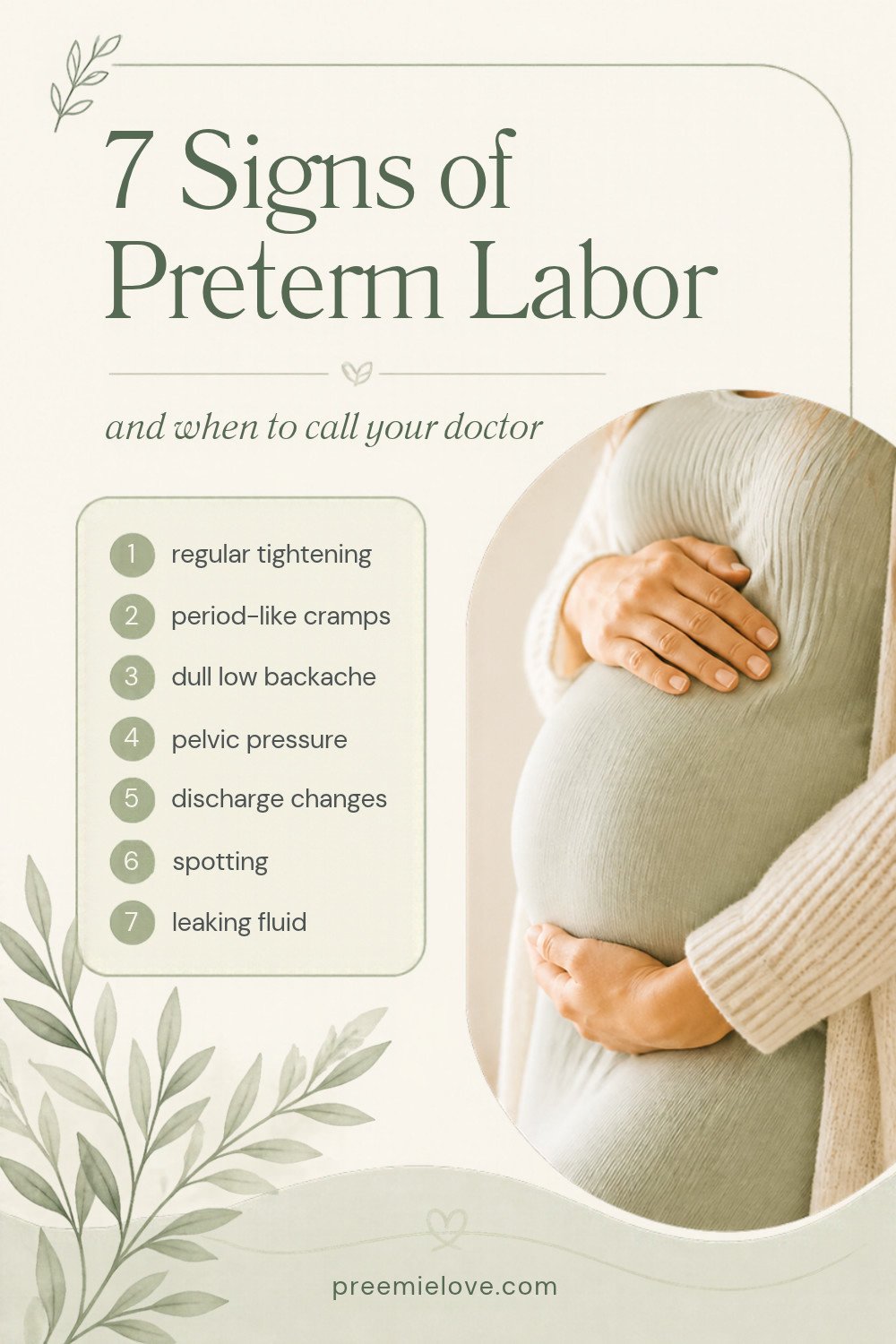
The 7 signs of preterm labor
These are the signs listed by March of Dimes and Mayo Clinic. You might have one, or several.
1. Regular or frequent tightening (contractions)
Your whole belly gets hard, then relaxes. March of Dimes describes it as your belly tightening “like a fist.” Preterm contractions may or may not hurt. Many care teams say to call if you have more than 4 in an hour, but your provider may give you a different number, so ask.
2. Period-like cramps
Mild cramps low in your belly that feel like your period is coming, sometimes with diarrhea. They’re easy to blame on something you ate.
3. A dull, low backache
Not the usual pregnancy back pain, but a constant, dull ache low in your back, or one that comes and goes in waves. If your back pain seems to have a rhythm, it’s worth a call.
4. Pressure in your pelvis
A heavy feeling low down, like your baby is pushing down. Some moms think their baby has simply “dropped.” Before 37 weeks, mention it to your provider.
5. A change in vaginal discharge
More discharge than usual, or discharge that’s watery, mucus-like, or tinged with blood.
6. Spotting or bleeding
Any vaginal bleeding in the second half of pregnancy should be checked the same day, even if it doesn’t hurt.
7. Your water breaks
This can be a big gush, like mine, or a slow trickle that keeps coming. If you’re not sure whether it’s urine, discharge, or amniotic fluid, call anyway. That’s a very normal question for the labor ward.
Preterm labor vs. Braxton Hicks
Braxton Hicks are practice contractions. They’re common and usually harmless. Here’s how they tend to differ from preterm labor:
| Braxton Hicks | Possible preterm labor | |
|---|---|---|
| Pattern | Irregular, come and go | Regular, or getting closer together |
| With rest or water | Usually fade | Keep going |
| Other signs | Usually none | Backache, pelvic pressure, cramps, discharge change, bleeding, or fluid |
The honest truth: it can be hard to tell the difference at home. Cleveland Clinic notes that regular or frequent contractions that don’t stop with rest, changing position, or drinking water are a concern. If you’re unsure, let your provider decide. That’s their job.
What to do if you notice a sign
- Call your provider or labor and delivery unit right away. March of Dimes says getting help quickly is the best thing you can do. Some older handouts suggest lying down and drinking water for an hour first. Follow what your own provider tells you, and when in doubt, call.
- Say your weeks first. For example: “I’m 31 weeks pregnant, and I’ve had six tightenings in the last hour.”
- Mention your history. A previous preterm birth, a short cervix, twins, or a cervical stitch changes how fast they’ll want to see you.
- Don’t drive yourself if you’re bleeding heavily or in strong labor. Call emergency services.
What happens when you get to the hospital
Your team will check you and your baby. This often includes a monitor to time contractions and listen to your baby’s heartbeat, and a check of your cervix by exam or ultrasound. Some hospitals also use a swab test called fetal fibronectin, which helps show whether birth is likely soon.
If you are in preterm labor, Cleveland Clinic lists treatments your team may offer:
- Steroid shots (corticosteroids) to help your baby’s lungs and organs mature.
- Magnesium sulfate, given before 32 weeks, which may lower the risk of cerebral palsy and other brain problems in the baby.
- Medicine to delay labor for a short time, so the steroids have time to work or so you can be moved to a hospital with a NICU.
Sometimes it turns out to be a false alarm. That’s a good outcome, not a wasted trip.
Who is at higher risk?
Mayo Clinic lists risk factors including:
- A previous preterm birth, especially recently or more than once
- A short cervix, or problems with the uterus or placenta
- Some infections, including infections of the amniotic fluid or lower genital tract
- Twins, triplets, or more
- Less than 18 months between pregnancies
- High blood pressure, diabetes, autoimmune disease, or depression
- Vaginal bleeding during pregnancy, or too much amniotic fluid
- Smoking or drug use, very stressful life events, and lack of prenatal care
Here’s what nobody told me: many preterm births happen to moms with no risk factors at all. March of Dimes says that in about half of cases, the cause is unknown. If your baby came early, it was not your fault.
Questions to ask at your next prenatal visit
- Which signs of preterm labor should make me call you, and what number should I call?
- How many contractions in an hour is too many for me?
- Do I have any risk factors? Will my cervical length be checked?
- Which hospital should I go to if labor starts early?
Our NICU parent questions checklist and first NICU visit checklist can help if your baby does arrive early.
Printable preterm labor warning signs
Screenshot this, or stick it on your fridge. Before 37 weeks, call your provider if you have:
| ☐ | Warning sign |
|---|---|
| ☐ | Belly tightening that is regular or frequent (more than 4 in an hour, or the number your provider gave you) |
| ☐ | Period-like cramps, with or without diarrhea |
| ☐ | A dull low backache that won’t go away or comes in waves |
| ☐ | Pressure in your pelvis, like the baby is pushing down |
| ☐ | More discharge, or watery, mucus-like, or bloody discharge |
| ☐ | Spotting or bleeding |
| ☐ | A gush or steady trickle of fluid |
My provider’s number: ____________ Labor and delivery: ____________
Frequently asked questions
Can preterm labor be painless?
Yes. Contractions may or may not be painful, according to March of Dimes. Some moms only notice pressure, a dull backache, or more discharge.
How many contractions an hour is too many before 37 weeks?
Many care teams use more than 4 in an hour as a reason to call. Ask your own provider what number they want you to use.
Can preterm labor be stopped?
Sometimes it can be slowed for a short time. That time is used to give steroid shots for your baby’s lungs, and sometimes magnesium sulfate to protect your baby’s brain. Whether labor can be delayed depends on your situation, which is why calling early helps.
Does stress cause preterm labor?
Very stressful life events are one of the risk factors Mayo Clinic lists, but stress alone rarely explains it. Many preterm births have no known cause.
Save this for later
Pin this list to your pregnancy board, or share it with a friend who’s expecting. It might be the reminder she needs.
Sources
All sources checked on November 21, 2026.
- March of Dimes: Signs and symptoms of preterm labor
- March of Dimes: Prematurity research
- Mayo Clinic: Preterm labor: Symptoms and causes
- Cleveland Clinic: Preterm Labor: Causes, Symptoms, Treatment and Prevention
- Valley Children’s HealthHub: Preterm Labor
This article is for general information only and does not replace advice from your doctor or midwife. If you think you might be in labor, call your provider or go to the hospital. See our full medical disclaimer.

Similar Posts