30 Week Preemie: Survival, Size, NICU Stay, and What to Expect
28-Week Preemie Mom & Founder of PreemieLove at PreemieLove
About this guide: Preemie Love is a parent resource, not a medical practice. This guide explains what parents commonly see when a baby is born at 30 weeks. It is not medical advice, and your baby’s NICU team and pediatrician are always the best source of answers about your baby. Read our medical disclaimer.
Last reviewed: November 27, 2026. Facts checked against the American Academy of Pediatrics (AAP), March of Dimes, CDC, WHO, and NIH-funded research.
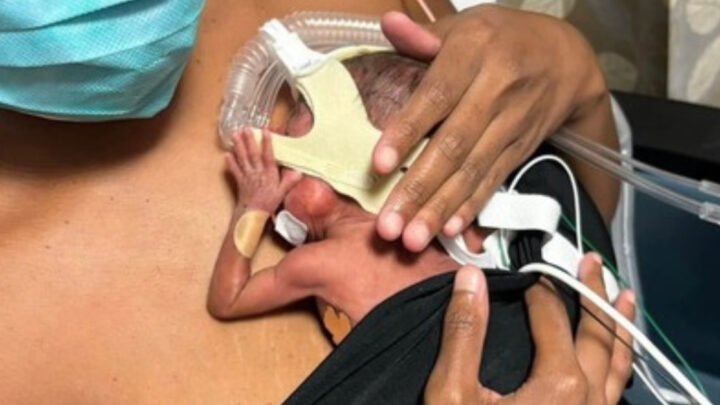
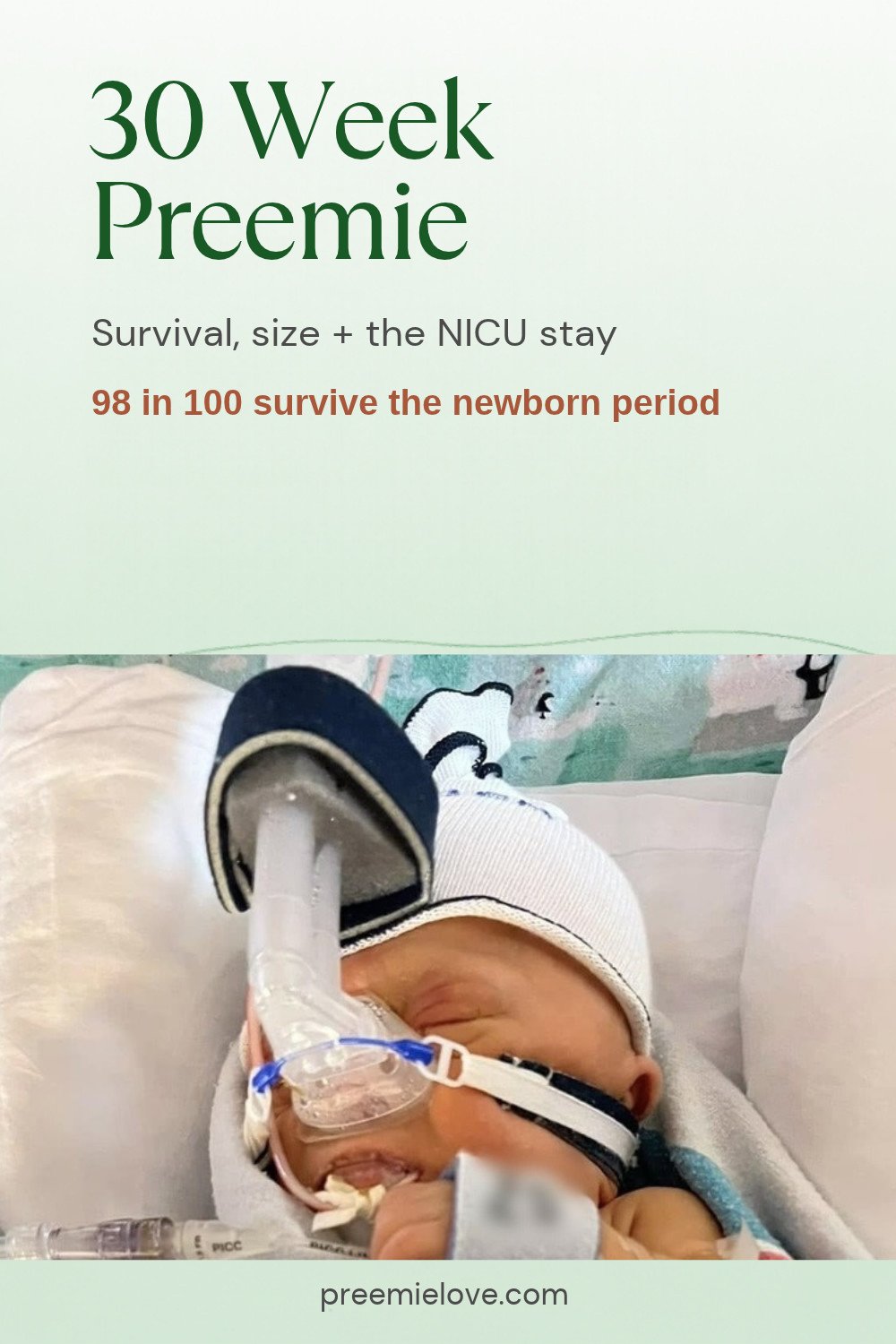
Thirty weeks. Your baby arrived about ten weeks early. They may weigh less than a bag of sugar, sleep most of the day, and wear a small mask or soft prongs to help them breathe.
If you are reading this from the NICU, here is the most important thing to know: the outlook for babies born at 30 weeks is very good. Almost all of them survive, and most go home a few weeks before their original due date. The weeks in between are about growing, learning to breathe steadily, and learning to eat.
This guide walks you through what to expect: survival, size, breathing, feeding, the checks your baby will have, how long the NICU stay usually lasts, and what comes after.
What is a 30 week preemie?
A full-term pregnancy is counted as 40 weeks. A baby born at 30 weeks arrives about 10 weeks, or about two and a half months, early.
March of Dimes calls babies born between 28 and 32 weeks very preterm. You may also hear the NICU team say “30 weeker” or “30 and 2” (30 weeks and 2 days). Those extra days matter a little, so ask the team for your baby’s exact age at birth.
At 30 weeks, the lungs, brain, gut, and eyes are still developing, but they are further along than they were even two weeks earlier. The NICU team’s job is to give each of those systems the support it needs while your baby grows.
What is the survival rate for a baby born at 30 weeks?
Very high. A study published in the American Journal of Obstetrics and Gynecology followed preterm babies born at 25 U.S. hospitals in the NIH-funded Maternal-Fetal Medicine Units Network. Of the 262 babies born at 30 weeks, 1.5% died as newborns. That means more than 98 out of 100 survived.
National numbers point the same way. CDC data for babies born in the U.S. in 2024 show that about 96% of all babies born at 28 to 31 weeks were still alive at their first birthday. That group includes babies born at 28 weeks, who face more risks, so the figure for 30 weekers alone is higher.
In the same U.S. study, 13.7% of babies born at 30 weeks had at least one major complication, such as a serious lung, brain, or bowel problem. Most babies had only minor, short-term problems, like needing breathing support for a while or treatment for jaundice. Your baby’s own health matters most, and your NICU team can tell you how your baby is doing day by day.
How big is a 30 week preemie?
Based on the 2025 Fenton preterm size charts, most babies born at 30 weeks fall in this range (10th to 90th percentile):
| Typical range in grams | About the same in pounds | |
|---|---|---|
| Girls born at 30 weeks | 1,194 to 1,735 g | 2 lb 10 oz to 3 lb 13 oz |
| Boys born at 30 weeks | 1,263 to 1,826 g | 2 lb 13 oz to 4 lb |
Most babies lose a little weight in the first days, then start to gain. Your baby’s doctors will track weight, length, and head size on a preterm growth chart and watch the trend, not one number.
What to expect in the NICU with a 30 weeker
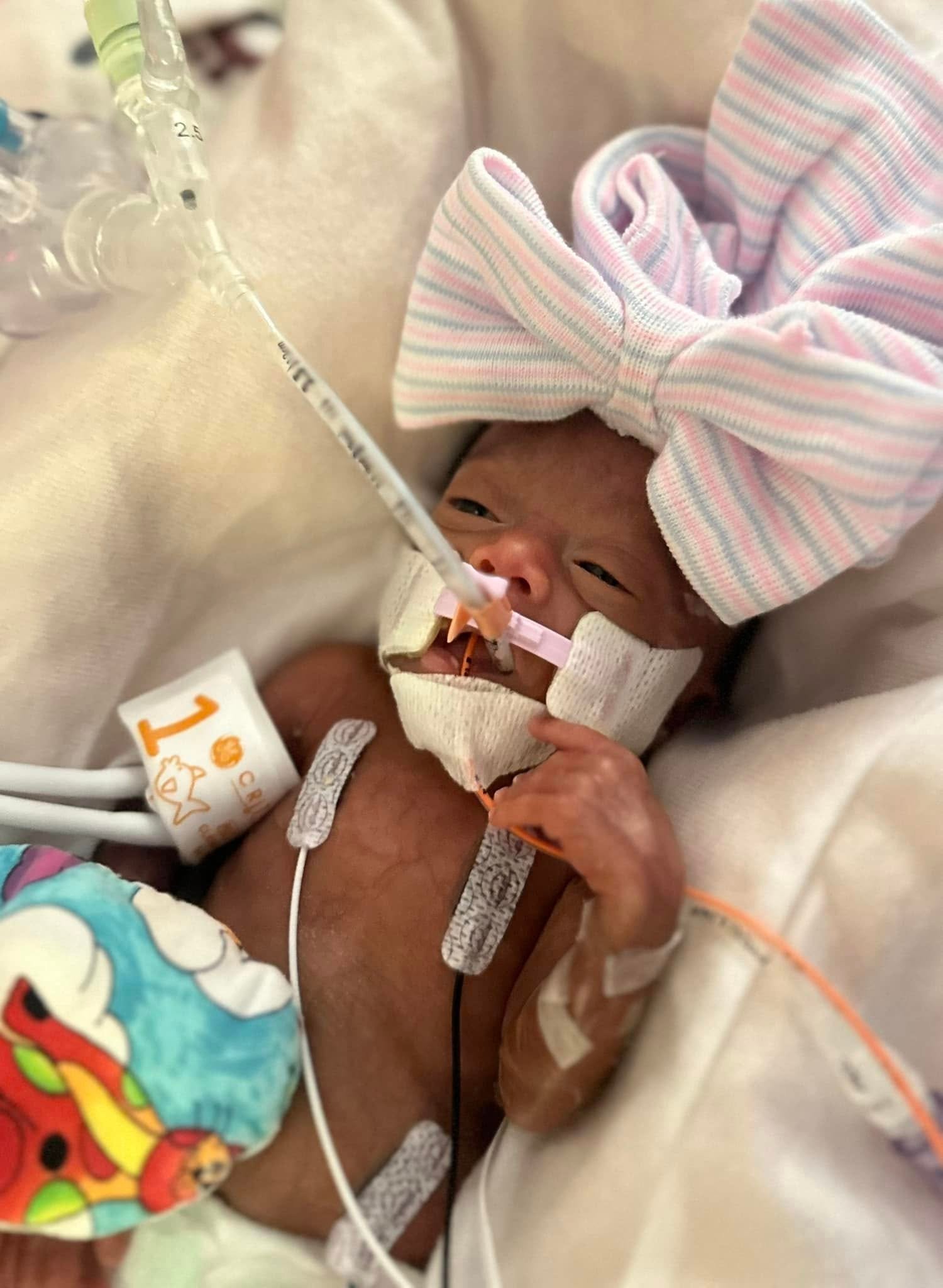
The first days can feel like a blur of alarms and new words. Our plain-English NICU glossary explains them, and our NICU parent questions checklist helps you keep track of what to ask.
Breathing
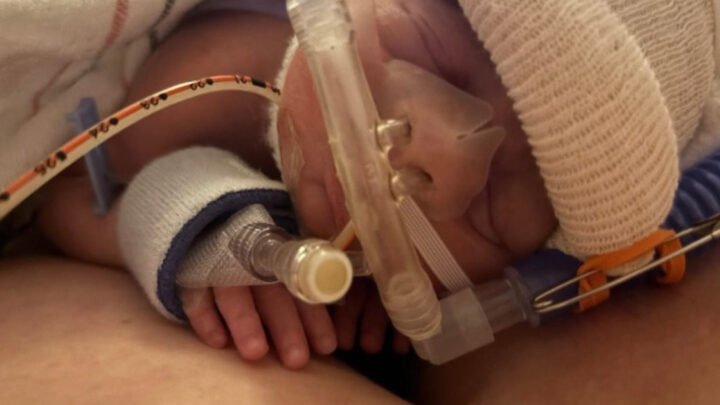
Many 30 weekers need some help breathing at first, because their lungs may not yet make enough surfactant, a substance that keeps the tiny air sacs open. Most get CPAP, a soft mask or prongs that give gentle air pressure. Some need a breathing tube and a ventilator for a short time, and some get surfactant medicine. Many babies move to lighter support, such as a small nasal cannula, within days to weeks.
Breathing pauses, called apnea of prematurity, are very common at this age. The NICU team watches for them on the monitor and often gives a medicine called caffeine. According to the AAP, these pauses usually stop by about 37 weeks postmenstrual age (weeks of pregnancy at birth plus weeks since birth). Babies usually need to go several days without a pause before they can go home.
Feeding
A 30 weeker usually cannot eat by mouth yet. At first, nutrition may come through an IV. Small amounts of milk start through a thin tube into the stomach and slowly increase until the tube does all the work.
Your milk matters a lot at this age. The AAP recommends that premature babies get their mother’s own milk whenever possible, and it is linked with a lower risk of a serious bowel problem called NEC (necrotizing enterocolitis). If your milk is not available, the AAP recommends pasteurized donor milk from a screened milk bank. Many very preterm babies need a “fortifier” added to the milk for extra protein and calories.
Start pumping as soon as you can after birth, and ask for help from a lactation consultant. Our pumping and bottle gear checklist for NICU parents lists what helps.
The skills to suck, swallow, and breathe together usually come between about 32 and 34 weeks. For a 30 weeker, that is only a few weeks away. Learning to take every feed by mouth is often the last step before going home. Our guide to slow-flow bottles for babies moving off tube feeds covers that stage.
Staying warm
A 30 weeker has very little body fat. Your baby will likely start in a warm isolette and move to an open crib once they can keep their temperature steady on their own, often in the 33 to 35 week range. You can usually touch your baby through the portholes from the first days.
Skin-to-skin (kangaroo) care
The World Health Organization recommends kangaroo care as routine care for all preterm and low-birth-weight babies. Many NICUs start skin-to-skin with 30 weekers early, even on CPAP, once the team agrees it is safe. It is one of the best things you can do for your baby, and for yourself. Ask your nurse when you can start. See our picks for kangaroo care shirts and skin-to-skin wraps.
Brain checks (head ultrasounds)
Babies born before 32 weeks have a higher risk of bleeding in the brain, called intraventricular hemorrhage (IVH), and of injury to the brain’s white matter. The Canadian Paediatric Society recommends a routine head ultrasound for all babies born at or before 31 weeks and 6 days, usually in the first 1 to 2 weeks, with a repeat scan at about 4 to 6 weeks. Most scans in 30 weekers are normal or show only a small bleed that does not cause lasting problems. Ask the team to explain each result.
Eye exams (ROP)
Babies born at 30 weeks or earlier get eye exams for retinopathy of prematurity (ROP), a condition where blood vessels in the back of the eye grow abnormally. For a baby born at 30 weeks, the first exam is usually about 4 weeks after birth. Severe ROP is much less common at 30 weeks than in babies born earlier, and it can be treated.
Infections, jaundice, and blood counts
Preemies are more prone to infections, so the team uses careful hand washing and watches closely for signs of illness. Jaundice (yellow skin) is common in the first week and is often treated with special blue lights. Some 30 weekers also need a blood transfusion for anemia (a low red blood cell count). Ask the team what each test or treatment is for. You are allowed to ask the same question twice.
30 week preemie NICU timeline: a typical path
This is a rough example for a 30 weeker without major complications. Every baby moves at their own pace, with good days and harder days.
| Baby’s age (weeks at birth plus weeks since) | What often happens | What you can do |
|---|---|---|
| 30 weeks (birth) | NICU admission, warm isolette, CPAP (sometimes a ventilator), possible surfactant, IV fluids, caffeine | Start pumping within hours if you can. Ask when you can touch and hold your baby. |
| 31 weeks | Tube feeds increase. First head ultrasound. Breathing support may step down. | Learn diaper changes, temperature checks, and mouth care with your milk. Try skin-to-skin when the team agrees. |
| 32 to 33 weeks | Full tube feeds. Some babies come off CPAP. First tries at breast or bottle may begin. | Keep a notebook of questions for rounds. Ask the lactation team about practice at the breast. |
| 34 weeks | First eye exam (about 4 weeks after birth). More feeds by mouth. Some babies move to an open crib. | Be there for feeds when you can. Pick a pediatrician. |
| 35 to 37 weeks | Getting ready to go home: all feeds by mouth, steady weight gain, no more breathing pauses | Get the car seat ready. Ask about the car seat test, hearing screen, follow-up eye exams, and RSV protection. |
How long do 30 week preemies stay in the NICU?
Usually around 5 to 7 weeks. In the U.S. study above, babies born at 30 weeks stayed in the hospital a median of 40 days, and half of them stayed between 31 and 48 days. That means many went home at about 35 to 37 weeks, a few weeks before their original due date.
Doctors do not use a fixed date or weight. The AAP says a preemie is ready to go home when they are:
- breathing on their own
- able to keep their body temperature steady
- able to feed by breast or bottle
- gaining weight steadily
Feeding is often what decides the date. It is common for a 30 weeker to be “ready” in every other way and still need a week or two to finish every feed by mouth. That does not mean something went wrong.
When that day gets close, use our NICU discharge checklist, our guide to car seats for small premature babies, and our preemie homecoming checklist.
Ask about RSV protection
RSV is a common winter virus that can make young babies, and especially preemies, very sick. The CDC recommends an RSV antibody shot for babies younger than 8 months who are born during or entering their first RSV season (usually fall through spring), unless the mother’s RSV vaccine during pregnancy already protects them. Ask your NICU team or pediatrician what applies to your baby.
Your 30 weeker’s adjusted age
Because your baby was born about 10 weeks early, their adjusted age (also called corrected age) is about two and a half months behind their actual age. At 6 months old, for example, a baby born at 30 weeks has an adjusted age of about 3 and a half months.
Use adjusted age for milestones like smiling, rolling, and sitting until about age 2. Vaccines still follow actual age. Our adjusted age guide and free calculator does the math. Then see our preemie milestones chart by adjusted age and our guides to 2-month and 3-month preemie milestones.
Long-term outlook for babies born at 30 weeks
Most babies born at 30 weeks grow up to walk, talk, play, and go to school like other children. Some need extra help along the way, and a few have lasting challenges. Knowing this helps you watch early and get support quickly.
- In EPIPAGE-2, a national study of preterm births in France, about 94% of babies born at 27 to 31 weeks survived to go home, and about 4.3% of children in that group had cerebral palsy at age 2. Babies born at 30 or 31 weeks are at the lower-risk end of that range.
- Very preterm babies are more likely to need help with movement, speech, learning, attention, vision, or hearing than children born at term. Many of these problems are mild, and early therapy helps.
Many hospitals invite very preterm babies to a NICU follow-up clinic to check development over the first years. Go to every visit you can. The CDC explains that if your child is under 3, you can also contact your state’s early intervention program yourself, without a doctor’s referral. Services are free or low cost for children who qualify.
Are you 30 weeks pregnant and worried about an early birth?
If you are reading this while still pregnant, know that doctors have proven ways to help a baby who may be born early. ACOG recommends a single course of steroid shots for pregnant people between 24 and 33 6/7 weeks who are at high risk of giving birth within 7 days. These shots help the baby’s lungs and lower some serious risks. Before 32 weeks, doctors may also give magnesium sulfate through an IV, which helps protect the baby’s brain.
Learn the 7 warning signs of preterm labor. If you notice any of them, call your doctor or midwife or go to labor and delivery right away.
30 weeks vs. 28 and 32 weeks: what’s different?
Two weeks makes a real difference in the NICU. Compared with a 28 weeker, a baby born at 30 weeks usually needs less breathing support, has a lower risk of serious brain, eye, and bowel problems, and goes home after about 6 weeks instead of about 10. Compared with a 32 weeker, a 30 weeker usually needs a bit more help at first and stays a couple of weeks longer. Read our guides to the 28 week preemie and the 32 week preemie to compare.
Taking care of you, too
A 30-week birth is often sudden. Even when the outlook is good, the NICU is hard on parents: the driving, the pumping, the alarms, the time away from other children or work. It is normal to feel shock, guilt, grief, fear, and fierce love all at once.
Please take care of yourself, too. Our emotional support guide for NICU parents has seven practical ways to feel less alone. Our NICU mom tote bag checklist and practical gifts for NICU parents (great to share with family who ask how to help) can make the long days a little easier.
When to call your baby’s doctor after going home
- You are worried about your baby’s breathing, feeding, color, or how sleepy they are. Your worry is enough reason to call.
- Your baby is eating much less than usual or has far fewer wet diapers.
- You think your baby may be sick or has a fever.
If your baby has trouble breathing, stops breathing, or turns blue or gray, call 911 right away.
Frequently asked questions
Can a baby born at 30 weeks survive?
Yes. In a large U.S. study, more than 98% of babies born at 30 weeks survived the newborn period. Most go home healthy after several weeks in the NICU.
Can a 30 week baby breathe on their own?
Some can, but many need help at first, most often CPAP. Breathing support is usually reduced step by step over the following days or weeks.
Do 30 week preemies need a ventilator?
Some do, usually for a short time. Many 30 weekers manage with CPAP alone. Your baby’s team will choose the gentlest support that works.
When will my 30 week preemie come home?
Often around 35 to 37 weeks postmenstrual age, a few weeks before the original due date. In a large U.S. study, the median hospital stay for babies born at 30 weeks was 40 days.
Is a 30 week preemie a micro preemie?
No. “Micro preemie” is an informal term usually used for babies born before about 26 weeks or weighing under about 1 lb 12 oz (800 g). Doctors call a 30 weeker very preterm.
When will my 30 weeker catch up?
The AAP says to use adjusted age for development until about age 2. By then, most preemies have caught up to the typical range. Some very preterm children need extra support for longer, and that is okay.
Sources
All sources checked on November 27, 2026.
- Manuck TA, Rice MM, Bailit JL, et al. Preterm neonatal morbidity and mortality by gestational age: a contemporary cohort. Am J Obstet Gynecol. 2016;215(1):103.e1–103.e14 (NIH PubMed Central).
- Ely DM, Driscoll AK. Infant Mortality in the United States, 2024: Data From the Period Linked Birth/Infant Death File. National Vital Statistics Reports 75(3), CDC, June 2026.
- March of Dimes: Preterm babies
- Fenton TR, University of Calgary: 2025 size for gestational age at birth table
- Eichenwald EC, AAP Committee on Fetus and Newborn. Apnea of prematurity. Pediatrics. 2016;137(1):e20153757.
- Study on suck-swallow-breathe coordination in preterm infants: PMC3669520 (NIH PubMed Central)
- American Academy of Pediatrics, HealthyChildren.org: Providing Breastmilk for Premature and Ill Newborns
- American Academy of Pediatrics: AAP updates clinical recommendations promoting use of human milk for preterm infants (2025)
- World Health Organization: WHO advises immediate skin to skin care for survival of small and preterm babies (2022)
- Canadian Paediatric Society: Routine imaging of the preterm neonatal brain (reaffirmed 2026); Hand IL, et al. Routine Neuroimaging of the Preterm Brain. Pediatrics. 2020;146(5):e2020029082.
- American Academy of Ophthalmology / AAP: Screening Examination of Premature Infants for Retinopathy of Prematurity (Fierson WM, et al. Pediatrics. 2018;142(6):e20183061)
- American Academy of Pediatrics, HealthyChildren.org: Going Home With Your Preemie
- CDC: RSV Immunization Guidance for Infants and Young Children
- American Academy of Pediatrics, HealthyChildren.org: Corrected Age for Preemies
- Ancel PY, Goffinet F, et al. Survival and morbidity of preterm children born at 22 through 34 weeks’ gestation in France in 2011: results of the EPIPAGE-2 cohort study. JAMA Pediatr. 2015;169(3):230–238.
- Pierrat V, et al. Neurodevelopmental outcome at 2 years for preterm children born at 22 to 34 weeks’ gestation in France in 2011: EPIPAGE-2 cohort study. BMJ. 2017;358:j3448.
- CDC: Learn the Signs. Act Early: early intervention contacts
- Baylor College of Medicine: Antenatal corticosteroids guideline (summarizing ACOG recommendations); MSD Manual Professional: Preterm Labor (magnesium sulfate before 32 weeks)
This article is for general information only and does not replace advice from your baby’s doctor or NICU team. See our full medical disclaimer.
Save this for later
Pin this to your Pinterest board so it is easy to find, or share it with a friend whose baby just arrived early.

Similar Posts