What Triggers Preterm Labor? 7 Known Causes, Risk Factors, and What Helps
28-Week Preemie Mom & Founder of PreemieLove at PreemieLove
About this guide: Preemie Love is a parent resource, not a medical practice. It is not medical advice. If you think you might be in labor, call your provider or go to the hospital. Read our medical disclaimer.
Last reviewed: November 22, 2026. Facts checked against March of Dimes, Mayo Clinic, ACOG guidance, the CDC, and the FDA.
When my water broke at 28 weeks, the first question I asked the doctor was “Why?” The second was “What did I do?” Nobody could give me a clear answer to the first. The answer to the second was: nothing.
If you’re pregnant and worried, or trying to make sense of an early birth, this guide explains what doctors know about what triggers preterm labor, what raises the risk, what usually doesn’t, and the steps that can actually help.
How common is preterm birth?
In the United States, about 1 in 10 babies is born before 37 weeks. The CDC’s latest provisional data put the preterm birth rate at 10.41% in 2025, the same as in 2024. So if this is happening to you, you are far from alone.
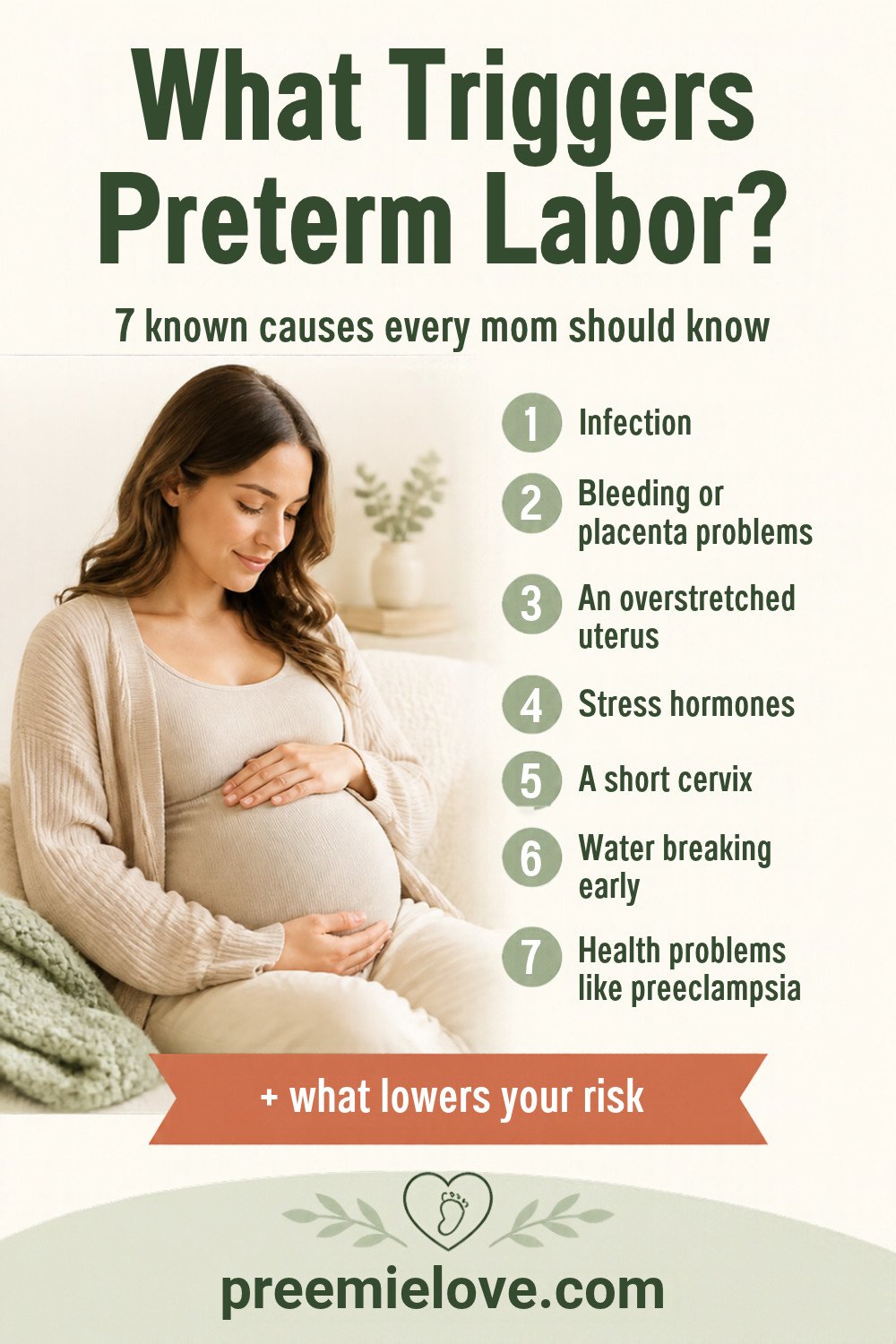
What triggers preterm labor: the 7 known causes
Researchers now see preterm labor as something that can start in several different ways, not as one single problem. These are the main triggers doctors recognize. More than one can happen at the same time.
1. Infection and inflammation
This is one of the most common triggers, especially in very early preterm births. Your body’s natural defense against bacteria releases chemicals that can make the uterus contract and the cervix soften. Infections of the urinary tract, vagina, or the fluid and membranes around the baby are all linked to preterm birth. Some of these infections cause no symptoms at all, which is one reason prenatal urine tests and checkups matter.
2. Bleeding and placenta problems
Bleeding inside the uterus, for example when the placenta starts to separate from the wall of the uterus (placental abruption), releases clotting proteins that can also set off contractions. Vaginal bleeding during pregnancy is a known risk factor, so any bleeding in the second half of pregnancy should be checked the same day.
3. An overstretched uterus
The uterus is a muscle, and stretching it can signal it to start working. This is a big reason why twins and triplets are often born early. Too much amniotic fluid (polyhydramnios) can do the same.
4. Stress hormones
Long-lasting stress in the mother, or physical stress in the baby (for example when the placenta isn’t delivering enough blood flow), can raise a hormone made by the placenta called CRH. This hormone is part of what normally starts labor at term, so too much of it too early may start labor early. This is about ongoing, heavy stress, not a single bad day.
5. A short or weak cervix
The cervix is the opening of the uterus. If it starts to shorten or open too early, often without any pain, labor can follow. A short cervix can be found with a transvaginal ultrasound, which is why your provider may measure it if you’ve had a preterm baby before.
6. The water breaks early
Sometimes the bag of waters breaks before labor starts and before 37 weeks. Doctors call this PPROM. That’s what happened to me. The cause often isn’t clear, but a hidden infection is a common reason behind it.
7. A health problem that means baby needs to arrive early
Not every preterm birth starts with labor. Sometimes the safest choice is for the care team to deliver the baby early, for example because of preeclampsia (a serious high blood pressure condition of pregnancy), a placenta problem, or concerns about the baby’s growth. These are called medically indicated preterm births. Preeclampsia alone accounts for about 6% of all preterm births in the US.
And then there’s the hardest truth: in nearly half of preterm births, no cause is ever found. Labor can start on its own, without warning, even when a mom has done everything right.
Who is at higher risk?
March of Dimes names three risk factors that make preterm labor most likely:
- You’ve had a preterm baby before
- You’re pregnant with twins, triplets, or more
- You have, or have had, problems with your uterus or cervix
Other risk factors from March of Dimes, Mayo Clinic, and ACOG guidance include:
- Getting pregnant again less than 18 months after giving birth
- Pregnancy after IVF
- Infections, especially of the urinary or genital tract
- High blood pressure, preeclampsia, or diabetes
- Vaginal bleeding during pregnancy, or too much amniotic fluid
- Anemia, especially early in pregnancy
- A past D&C procedure, which raises the risk by about 30% after one procedure
- Smoking, drinking alcohol, or using drugs
- A lot of stress, or very stressful life events
Having a risk factor doesn’t mean you will deliver early. And having none doesn’t mean you can’t. Many moms in NICUs, including me, had no risk factors at all.
What usually does NOT trigger preterm labor
A lot of moms carry guilt for things that didn’t cause their early birth. Here is what the evidence says about some common worries:
- Sex in a low-risk pregnancy. Studies of women with low-risk pregnancies found no increase in preterm labor from sex. If you have placenta previa, a short cervix, bleeding, your water has broken, or you’ve had preterm labor before, ask your provider what’s safe for you.
- Normal daily activity. Everyday tasks and gentle exercise that your provider has approved are not known causes. Strict bed rest is no longer routinely recommended to prevent preterm birth.
- One stressful day. The stress link is about heavy, ongoing stress. An argument or a hard week did not cause your baby to come early.
What can lower your risk
You can’t prevent every preterm birth. But these steps can make a real difference, especially if you have risk factors:
- Start prenatal care early and go to every visit. Tell your provider about any past preterm birth, miscarriage, D&C, or cervical procedure.
- Ask about cervical length checks if you’ve had a preterm baby before. ACOG guidance recommends repeat ultrasound measurements between 16 and 24 weeks for moms with a past spontaneous preterm birth.
- Ask whether progesterone is right for you. Daily vaginal progesterone, prescribed by your provider, can lower the risk for moms with a short cervix. Note that the weekly shot called Makena, which older articles mention, was withdrawn by the FDA in 2023 because it wasn’t shown to work.
- Ask about a cervical stitch (cerclage) if your cervix is short or opening early. Your provider will tell you whether it fits your situation.
- Ask about low-dose aspirin if you’re at high risk for preeclampsia. The US Preventive Services Task Force recommends it after 12 weeks for high-risk moms, which can also lower the risk of preterm birth. Only take it if your provider recommends it.
- Report infection signs quickly, like burning when you pee, unusual discharge, or fever.
- Stop smoking, alcohol, and drugs, and ask for help if you need it. It’s never too late in pregnancy for this to help.
- Manage ongoing health conditions such as high blood pressure and diabetes with your care team.
- Space your pregnancies. For most women, waiting at least 18 months before getting pregnant again lowers the risk.
Know the signs, too
Knowing the triggers is helpful, but knowing the warning signs is what helps in the moment. Regular tightening, period-like cramps, a dull low backache, pelvic pressure, a change in discharge, spotting, or leaking fluid before 37 weeks all mean it’s time to call. Read our full guide: Signs of Preterm Labor: 7 Warning Signs and When to Call.
If your baby does arrive early, our first NICU visit checklist and NICU parent questions checklist can help you through the first days.
Questions to ask your provider
- Do I have any risk factors for preterm labor?
- Will you check my cervical length? When?
- Am I a candidate for progesterone, a cerclage, or low-dose aspirin?
- Which infection symptoms should make me call you?
- Is sex and exercise safe for me in this pregnancy?
Frequently asked questions
What is the most common cause of preterm labor?
Infection and inflammation are among the most common known triggers, especially for very early births. But in nearly half of cases, no cause is found.
Can stress cause preterm labor?
Heavy, long-lasting stress is a known risk factor and may play a part through stress hormones. Everyday stress or one hard day is not considered a cause.
Can dehydration trigger preterm labor?
Dehydration can make Braxton Hicks practice contractions more noticeable, and drinking water often eases them. It is not listed as a main cause of true preterm labor. If contractions are regular or don’t stop, call your provider rather than waiting.
If I had one preterm baby, will it happen again?
The risk is higher, but many moms go on to have full-term babies. ACOG notes that having a full-term birth after a preterm one lowers the risk for future pregnancies. Early care, cervical length checks, and progesterone when needed can help.
Was it my fault?
Almost always, no. Preterm labor often starts with no warning and no known cause. If your baby came early, please be gentle with yourself.
Save this for later
Pin this list to your pregnancy board, or share it with a friend who’s expecting.
Sources
All sources checked on November 22, 2026.
- March of Dimes: Preterm labor and preterm birth: Are you at risk?
- Mayo Clinic: Preterm labor: Symptoms and causes and Diagnosis and treatment
- American Family Physician: Predicting and Preventing Preterm Birth: Recommendations From ACOG
- CDC National Center for Health Statistics: Births: Provisional Data for 2025
- FDA: Makena (hydroxyprogesterone caproate injection) Information
- US Preventive Services Task Force: Aspirin Use to Prevent Preeclampsia
- Goldenberg RL et al., BMC Pregnancy and Childbirth: Pathways leading to preterm birth
- CMAJ: Sex in pregnancy
This article is for general information only and does not replace advice from your doctor or midwife. If you think you might be in labor, call your provider or go to the hospital. See our full medical disclaimer.

Similar Posts